A Conversation with Lisa Low
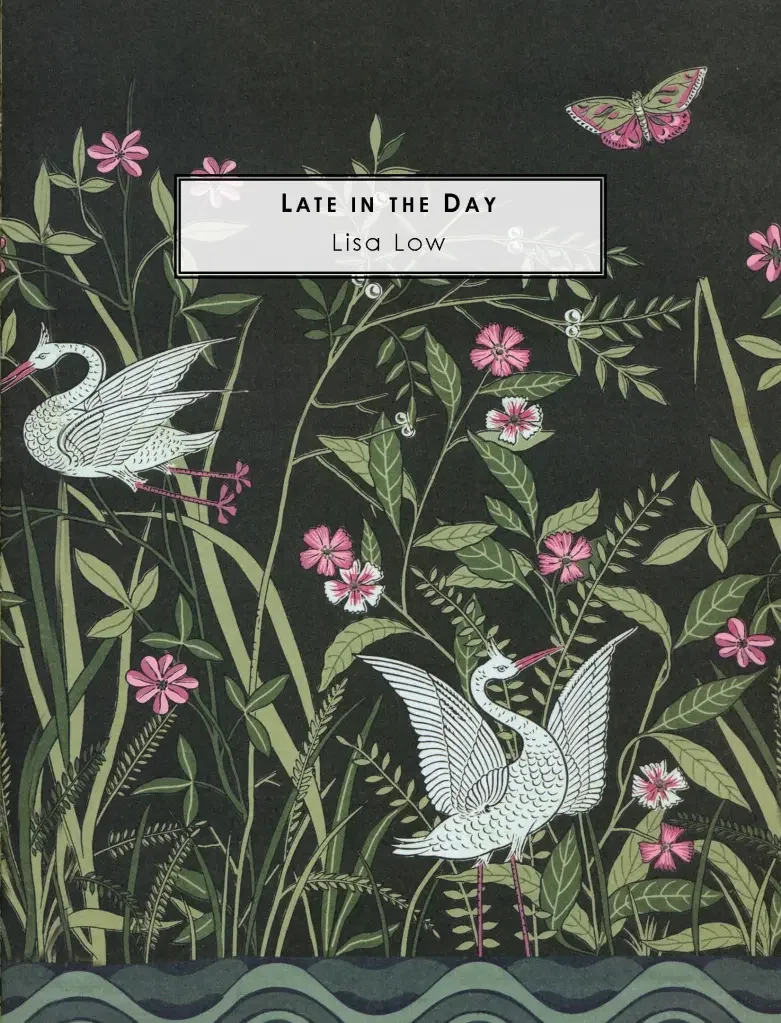
Spending time with DIHP alumna Lisa Low’s poetry always feels to me like sitting down with an old friend. She has a unique gift of inviting the reader to make a space at her table, even if they’ve never set foot in her imagery before. To celebrate the recent release of her chapbook, Late in the Day, we asked her to sit down and chat with us about poetry, music, and, of course, pockets. — CMG
~
1. Let’s start with the big question: What is your favorite pocket?
You mean besides Does It Have Pockets? A big one of course. The bigger the better. I always like putting my hands in my pockets.
2. What is the strangest place you’ve ever given a reading?
I think it was at a Manhattan Arts Festival, up on East Eighty-First Street, standing next to a guy with a metal cart selling canned soda and pretzels. Except for the very occasional person who stopped to listen to a poem or two, almost everyone walked by, busy with their own lives, as if I weren’t there making a fool of myself with a little card table set up on the corner.
3. All kidding aside, what part do you think poetry is playing in the social consciousness at the moment?
There’s a perspective that says poetry has flourished especially since the pandemic. Certainly, the poetry world is incredibly active. I can hardly believe how many people are writing poetry and how many journals there are out there. On the other hand, in America, I think poetry has always been something most people shy away from. I believe Ben Franklin said America has a place in its heart for everything but poetry. Most people don’t know what to make of it. If for poets, there is a vibrant world, in my experience, people outside the poetry world rarely experience, or want to experience, poetry. It’s foreign. A scary, elevated, unknowable thing that can make people feel inadequate. There are poets like Mary Oliver and Billy Collins whose work is so brilliant and clear it breaks through to the general population. But that’s hard to achieve.
On the other hand, and this will sound counter to what I just said, I also want to say how incredibly important poetry is to political consciousness. How much poetry can play a role in educating people about civil rights, environmental rights, war, misogyny and other social ills. Poetry is truth telling. A lot of people are afraid to look at the truth. Poetry puts you there; makes empathy, shared experience, possible. One poem can change a person’s life forever. The right poem; the right words in the right order, can turn you against war, or eradicate the urge to racism or misogyny, for example.
4. Where did the title of your new chapbook, Late in the Day, come from?
It just popped into my head, but as a friend pointed out (duh), it’s the title of one of the book’s key poems, central to my consciousness, about the last time I saw my father. Also, I am 73 now so I am literally “late in the day” so I think there’s that, too. I’ve wanted to be a poet for as long as I remember and I’ve always written poetry, since I was a teen-ager; and I’ve always more or less recognized myself as a poet (without always having the confidence to state it publicly and frankly: I am a poet), but I’ve also had a busy life in terms of career and children and it’s not really been until I retired about four years ago that I could finally swivel my head around and look straight into the heart of poetry which I’ve been doing for the last few years. Publishing a book of poetry is something I hoped to do before I die. I wasn’t sure it would happen, but bizarrely, Late in the Day was the first manuscript I ever sent to a publisher. To my amazement, it got taken by Seven Kitchens Press. I have another book---70 poems about my Dad—called Rapscallion that I’ve been working on for the past year that I’ll be sending out soon. Wish me luck!
5. What was the process of curating the book; how did you pick and choose what to include and what, if anything, influenced those choices?
You know, I went round and round thinking of different themes and arrangements, but in the end, I largely selected poems that had been accepted by one or sometimes two presses at once (though I could only publish them in one place). Those were poems I knew had immediate appeal. From there, I picked and arranged the ones that seemed to adhere in a ring, one to the other.
6. In your DIHP poems such as “Henrietta” and “Remarkable Things,” you have a remarkable ability to cinematically illustrate a moment in time. Is your brain constantly photographing the world? Do you catalogue those moments to use later? Are you shuffling images, words, or both in your mind as you write or is the process completely different?
I really like that description, Camille, of how the poems appear to you because it is really quite accurate. My great uncle had a photographic memory. According to my mother, the police used to call him because he would sit on the porch in his old age and memorize license plates. I think I inherited that: from a very early age, I believe my memory’s been photographic. But that bright outer ring of memory, what happened, is overlaid with blurry interiors. I think my brain is full of what Wordsworth called “spots of time”---moments where time stopped and everything changed. And you only have to reach back and touch such a moment, sometimes, for a poem to spring to life.
7. One of the things you also consistently achieve in your poetry is relaying personal experience while concurrently making room – even welcoming – the reader into the scene. Do you think about your reader when you’re drafting or editing or is that a natural part of your poetry?
I think I am always aware of the reader in the room. I don’t write to the reader, but I know he or she is there, a fellow human, ready to receive, ready to be talked about or dipped into. But on the other hand, I do believe I’m a singularly lonely isolated person. But I think we all are. Our consciousnesses are our own---no one else can really see inside. Poetry is about the best avenue I can think of for that. For turning the inside out, for showing yourself to others. I guess the hope is that you get to meet the reader there, ameliorate the loneliness for both of you, in the poem in a shared self.
8. I was thrilled when I found out that, like me, you are also a pianist. What are you working on right now at the bench? How does your musicianship influence your writing?
Right now I am working on Mozart’s Piano Sonata in C, k. 547, the so-called simple sonata (which isn’t so simple). I’ve had people tell me that my poetry is musical; very close to the ear and I think that’s true. I think whatever attracts me to poetry is probably the same thing that attracts me to music. The truth is I love art, any art. Not that I love any art, but art — beauty and truth — is my mind’s prevailing interest and always has been — whether it’s visual, auditory, verbal. I think that’s because I’m deeply emotional and I can’t avoid that, much as I might like to. It has always seemed my role from an early age to explore and express the emotions, positive and negative, which I think a lot of people prefer to hide from. Emotions are plastic and elastic; like clay in your hands. They can lead you down some very dangerous, but also onto some very thrilling paths. Robert Frost described poetry as a momentary stay against chaos. Music and poetry are both ways to structure, to hold onto and understand, the fleeting chaos of emotion.
9. What question do you wish we would have asked?
Maybe where’s the best place I’ve read or the best person I’ve read with? I sat on a three-person panel with Grace Paley once and that was fabulous; I read at the 92nd street Y and that was fabulous, too. I got to study with the poet George Barker, one on one, as an independent study, as an undergraduate. I grew up in the same town as Sylvia Plath and we had the same English teacher in High School, Wilbury Crockett. And I went to school in the same elementary school, Brown School, where Anne Sexton went to school. These are all little interesting intersections between my personal life and time. Little colorful brushes, resting points, between my life and the world.
10. How can readers find more of your work and where is the best place to order your new book?
For the moment the book is sold out at Seven Kitchens, but you can request a copy of Late in the Day from me directly at lisalowwrites@gmail.com. I will be thrilled to hear from you. You can also keep an eye out for my first full book of poetry, Rapscallion, which I am just finishing and which I hope to see in print in 2026.
~
Our heartfelt congratulations to Lisa on the recent release of Late in the Day and the upcoming Rapscallion. We are grateful to Lisa for taking the time to answer our questions with such great care. To conclude, please enjoy a trio of poems from Late in the Day, as selected by the Pockets team:
Floating for Eva — After Joan Miró
In the painting class at the retirement home in Florida
We live in a land of palm trees and roses
and float like balloons on canvases
green and blue. By day we are free
to paint, as if forever. By night,
we weave through the stars, dragging
our umbilical cords like kite strings
behind us. No longer beautiful;
no longer tied to hard necessity,
tender is the night we share,
provisioned for eternity. When
we lose our hands, we will paint
with our teeth. When we lose
our teeth, with our gums.
This poem was first published at Tusculum Review.
The Last Time I Saw My Father
The last time I saw my father, he stood
like a pillar on the Florida doorstep,
his still-living head, drenched like a globe
in watery light, dressed in a bathrobe
late in the day, lifting his hand to wave
goodbye. It was the opposite of coming to be.
It was a cracking and breaking; a thunderous
wracking, along the last, thin wall of age,
his eyes wet with sorrow, leukemia blue,
his mind leaking slow. There was nothing
pretty there. Nothing virgin, holy, baby soft,
or true. Nothing a tourist would want to stay
to see. Let death be later. Let death be tomorrow.
Eyes look your last. Death is coming now.
This poem was first published at Conduit.
On a Sunny Day, I Hear My Neighbor’s Voice
Everyone knows he’s a bully; all the neighbors
know to back away when he comes; even
the Sheriff knows to call for back up
when that red-faced hulk bulks into his rear view;
but today he’s teaching a high-pitched batch
of fourth graders in eco-safety. I crane my neck
amazed to hear that sweet voice talk, peek
through the fence, and watch him bend,
and, with a gentle hand, lead the small
of a small boy’s back, back to the pond,
for today, he’s teaching the children belted
at his waist what food the frogs will need
to survive. Such happiness in that voice. Not
having to be a bully here. Not having to be a bully now.
This poem was first published at Pleiades.
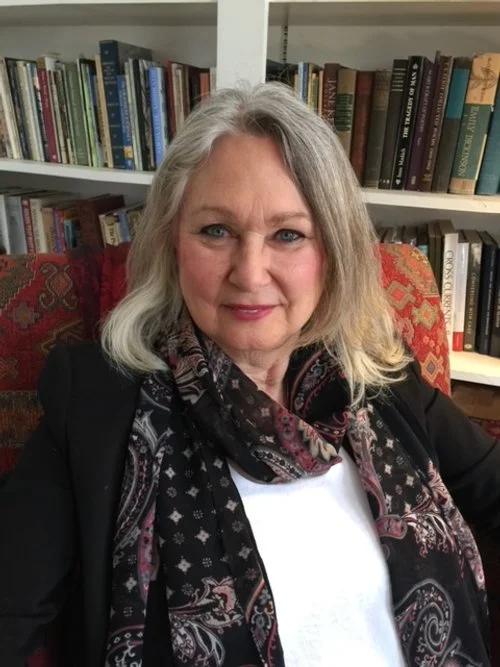
Lisa Low, Ph.D., is a poet, scholar, book reviewer, and former English professor living in Connecticut. She was first runner-up for the Shakespeare Prize at University of Massachusetts, Amherst. Her poetry has been shortlisted for Ploughshares and nominated for Best New Poets 2025. Her work has appeared in many literary journals including The Adroit Journal, The Boston Review, The Massachusetts Review, Pleiades, and The Southern Indiana Review. She is the author of the poetry chapbook Late in the Day (Seven Kitchens Press, 2025). She taught English literature at Boston University, Cornell College, Colby College, and Pace University.